Friday, March 23, 2018
"Allure" Print and Free Hi-Res image
Hi Everyone,
Wow, it's been a long time since I've posted on here. So I tried to upload a hi-res image here for you not realizing the limitations of Blogger and my own limitations of not wanting to learn how to properly make it accessible. However, I'd still like to make the image available if interested. Feel free to leave an email in the comments and I'll send you the image.
If you'd like a print of "Allure" you can grab one here https://www.inprnt.com/gallery/ericfortune/allure/
Wednesday, January 7, 2015
"Driverless" Where are we going?
By Eric Fortune
![]() |
| "Driverless" 20 x 15" acrylic on watercolor paper |
I am interested in art as a means of living a life; not as a means of making a living."~Robert Henri
This is my favorite quote about art. I hope it becomes more apparent why by the end of this post.
Recently I’ve had the honor of having some paintings featured at the SCOPE Art Fair in Miami. I’ve done a ton of articles and videos on technique and how I go about making an image. Today, I’d like to talk about the content and inspiration behind this piece.
What does a world with driverless, automated cars look like? How could it potentially change our cultural values and our economy?
Does it make sense that most cars spend 90% of their time in parking lots? Cars aren’t cheap and it’s kind of a shame they’re not being utilized more. What if cars didn’t spend 90% of their time in parking lots? What if they spent 90% of their time driving around, picking up and dropping off people continuously? With automated, driverless cars this makes lots of sense. However, what does this mean for car sales and ownership? If you can basically get access to a car whenever you need it, would you still want to own your own car? Would these fleets of automated cars be like a publicly owned transport system? Would you miss paying insurance, gas, oil changes, and other forms of continuous maintenance, and waste time looking for parking spots for a car that you use only 10% of the time? Most importantly, what does not owning a really expensive car and sharing automated vehicles instead say about your penis size?
“You’ll never own a car again. I have two two and a half year old boys. They’re not going to drive when they turn 18. They’re going to have an autonomous car driving them around. Every single car company has announced autonomous cars in their future.”
~Peter Diamandis, founder and chairman of the X Prize Foundation, Singularity University and the co-author of the New York Times bestseller "Abundance: The Future Is Better Than You Think".
So I guess us guys will have to find another way to overcompensate for our penises. Just for the record I think minivans are pretty amazing.
But would a fleet of autonomous cars really be as efficient or convenient as owning your own personal car?
![]() |
| "Yeah, if you could take me to the chopper pronto that would be great. Mmm k, thanks." |
“You may remember Larry Burns the number two at General Motors, for many years the Vice President of New Car Development. He’s now at the University of Michigan. He did an amazing study. Ann Arbor is a pretty big sized city and he found that even today with the rudimentary Internet of Things platform: communication, energy, logistics internet, in Ann Arbor you could get the same convenience and mobility moving from ownership to access using 80% fewer vehicles right now.”
~Jeremy Rifkin, president of the Foundation on Economic Trends and author of the recent book “Zero Marginal Cost Society” (fascinating book, highly recommend)
Everyone take a second to imagine what your city might be like with 80% fewer cars. What are some of the implications here?
![]() |
| Let's be honest. Somewhere deep down inside, you would miss this. |
Less traffic, less pollution, less car related incidents and injuries, and less transport jobs etc. Excellent, so when is this all happening? Fifteen, maybe twenty years? In October of 2014 Elon Musk, the CEO and chief product architect of Tesla Motors stated that “self-driving technology will outpace the skill of human drivers in five to six years”. However, he warned that it would take regulators another two to three years to approve the autonomous cars for use in public. This is a glimpse at how driverless, automated cars specifically might affect society in the near term. Let’s expand our scope to include other forms of automated technologies.
In Jan of 2013 I wrote a post titled “Art and The Singularity” discussing how the exponential advancement of computing power and automated technologies appear to be having some profound affects on our lives, the amount of available jobs, and how our economy operates. Before moving on here’s a quote from MIT researcher Andrew McAfee worth revisiting,
"It's in the second half of the chessboard that that constant doubling yields numbers so big that our intuition falls apart, that prior experience falls apart.
So when we were writing our book, we did just a quick back-of-the-envelope calculation. The U.S. started tracking computers as an investment category in 1958, and the standard period for doubling of computer power is 18 months. You do a little bit of math, and that quick estimate tells you that we entered the second half of the chessboard in about 2006 with computers, which helps me understand why we've got Google cars and Siri and Watson and all these robots coming at us just in the past few years. If this analogy holds up at all, the only real conclusion is we ain't seen nothing yet."
~ Andrew McAfee, author of "Race Against the Machine" on NPR
2006, that was 8 years ago, and 2015 is right around the corner. It’s been almost two years since I wrote that last post, so what’s happened since then? Well, earlier in 2014 researchers at Oxford came out with a Report stating that
"It's in the second half of the chessboard that that constant doubling yields numbers so big that our intuition falls apart, that prior experience falls apart.
So when we were writing our book, we did just a quick back-of-the-envelope calculation. The U.S. started tracking computers as an investment category in 1958, and the standard period for doubling of computer power is 18 months. You do a little bit of math, and that quick estimate tells you that we entered the second half of the chessboard in about 2006 with computers, which helps me understand why we've got Google cars and Siri and Watson and all these robots coming at us just in the past few years. If this analogy holds up at all, the only real conclusion is we ain't seen nothing yet."
~ Andrew McAfee, author of "Race Against the Machine" on NPR
2006, that was 8 years ago, and 2015 is right around the corner. It’s been almost two years since I wrote that last post, so what’s happened since then? Well, earlier in 2014 researchers at Oxford came out with a Report stating that
“According to our estimates around 47 percent of total US employment is in the high risk category. We refer to these as jobs at risk – i.e. jobs we expect could be automated relatively soon, perhaps over the next decade or two.”
To help give a little context to this 47% number, during TheGreat Depression unemployment was about 25%. Ouch. That sucks. Of course, we live in a system of global interacting economies. How would another Great Depression in America affect the other economies around the world? And this could happen within the next decade or two? Impossible right? Sounds a little hyperbolic and ridiculous perhaps? Well, not long after another study came out echoing the Oxford Report finding that
“Fifty-four percent of jobs in the 28-member European Union are at risk of advances in computerization, according to a study by economist Jeremy Bowles published by Bruegel, a Brussels-based research organization.”
Something here that I think is worth noting, the 47% and 54% of jobs potentially lost to automation are very important numbers, in fact, a bit mind boggling. But what I’m more curious about is this 25% unemployment during the Great Depression. When might we potentially hit that number? Would we see a mirror of what happened during the Great Depression? In my mind by the time we hit half of the population being unemployed we’ve already arrived at the Thunderdome. Not in the parking lot and walking to the Thunderdome, more like inside of the Thunderdome and hanging from a body harness. You won’t even need those tiny binoculars. I know what you’re thinking at this point, you’re gonna bring your tiny binoculars just in case, cause seriously, you don’t want to miss out. I’m right there with ya, tiny binoculars, check.
![]() |
| Factoid. "Mad Max Beyond Thunderdome" was Richard Amsel's last film poster illustration. Click the hyperlink for an excellent reproduction of this piece online. |
So the question we should all be asking ourselves is “WHEN DO WE START SMASHING ALL THE MACHINES!?!”. And why would we smash all of the machines? In order to save many of the jobs that we all love so dearly of course, jobs that pay fair wages, jobs that don’t stress us to death, jobs that leave us with plenty of time to nurture our families and interpersonal relationships, or heaven forbid work on some personal art projects that have been on the back burner for years.
Don’t worry all you digital artists we’ll save the art software for you. But surely we can’t have people running around without forcing them into some form of labor right? So if we’re not going to smash all the technology (sad face) what are some of our options?
In my previous post, Art and The Singularity, I didn’t really go into possible solutions for this conundrum as much as I was describing the problem of technological unemployment and exponential growth in an economic system based on work for income. Though, I had brought up the notion that society could choose to have a reduced work week, perhaps a 30 hour work week. As a reminder, a 30 hour work week almost passed in 1933.
"Much to the surprise of the country, The Senate passed the Black Bill on April 6, 1933, by a vote of 53 to 30, mandating a 30-hour week for businesses engaged in interstate and foreign commerce. ...Roosevelt later "voiced regret that he did not get behind the Black-Connery 30 Hour Week Bill and push it through Congress."
But one must surely see the trend here. Once upon a time 16 hour days, 6 days a week was the norm. Eventually, over time and through lots of civil unrest and people sacrificing their lives, workers won a 14 hour work day.
![]() |
| "What a relief! Those 16 hour days were busting my yet to drop balls. I can finally relax with a nice 14 hour day of work. Ahhh, being a 5 year old is awesome." |
Then eventually workers fought for the 12 hour day, the 10 hour day, and now the 8 hour day/40 hour week. Of course, most freelance artists I know still work long hours as well as the weekends. The question I’m asking is if technology improves to the point that just to have something near full employment, a mandatory 30 hour work week has to be implemented, what will stop technology from improving further still and forcing us to a 20 hour work week? Surely, it won’t stay at 20 hours for all of eternity. So when does a 15 hour work week kick in right? Once again, it’s starting to feel like we’re in looney land. Noted economist John Maynard Keynes predicted in his essay “Economic Possibilities for our Grandchildren” written in 1930, that due to such technical efficiency and abundance, we eventually would have so much leisure time that one of our biggest problems would be occupying our free time to keep us from going crazy.
”Three-hour shifts or a fifteen-hour week may put off the problem for a great while. For three hours a day is quite enough to satisfy the old Adam in most of us!”
~John Maynard Keynes
![]() |
| In "The Jetsons" George Jetson actually worked a three hour day and for three days a week. Should we be taking notes? Where did we go wrong? |
More and more modern day economists seem to be admitting that Keynes was most likely right in his prediction but was off by some years. It’s more a matter of when it will happen than if it will happen. Here’s what some other people who study this are saying:
"If one machine can cut necessary human labor by half, why make half of the workforce redundant, rather than employing the same number for half the time? Why not take advantage of automation to reduce the average working week from 40 hours to 30, and then to 20, and then to ten, with each diminishing block of labor time counting as a full time job? This would be possible if the gains from automation were not mostly seized by the rich and powerful, but were distributed fairly instead.
Rather than try to repel the advance of the machine, which is all the Luddites could imagine, we should prepare for a future of more leisure, which automation makes possible. But to do that we first need a revolution in social thinking."
~Lord Skidelsky, Emeritus Professor of Political Economy at the University of Warwick
(seriously though, I’m sure we can find something to smash)
Another quote from Marshall Brain
“..we should redesign the way the economy works so that we all get the benefits of all this automation.
So, how might you do that?
-Spread the benefit of productivity increases to everyone.
-Break the concentration of wealth
-Increase pay for everybody
-Reduce the work week, you would say ‘hey, this 40 hour work week, we’ve had it forever. Let’s make it 35, then 30, then 20 til we’re all on perpetual vacation’.”
~MarshallBrain, formerly taught in the computer science department at NCSU, and founder of How Stuff Works speaking at Singularity Summit.
So, how might you do that?
-Spread the benefit of productivity increases to everyone.
-Break the concentration of wealth
-Increase pay for everybody
-Reduce the work week, you would say ‘hey, this 40 hour work week, we’ve had it forever. Let’s make it 35, then 30, then 20 til we’re all on perpetual vacation’.”
~MarshallBrain, formerly taught in the computer science department at NCSU, and founder of How Stuff Works speaking at Singularity Summit.
![]() |
| Perpetual vacation?! That sounds...horrible ish. Must...smash...robots... |
So besides reducing work hours to spread around the remaining yet to be automated work load what other options are there? Here’s what some are saying (I know, I’m a quote whore but it’s really much less impressive if someone were to say “Hey, Eric Fortune said this thing.” If this ever happens you have my permission to smack this person. But get their consent first and have a safe word. Always have a safe word.)
"I think that we do need to seriously think, particularly as productivity increases, technological change provides us with great benefits but requires fewer and fewer people to actually do the work. The robots are going to be doing more and more. We've got to seriously think about how we widen the circle of prosperity, how we get shared prosperity. Otherwise, who's going to be the customer? And a Minimal Guarantee with regard to income, it seems to me, it's almost inevitable in terms of the direction that the structural changes of our economy are taking us in."
~Robert Reich, former Secretary of Labor and star of the new documentary "Inequality for All"
"The very conventional solution that we're always offered which was give people more training, give them more education so they can do a higher level job, that simply may not work because those jobs are also quite likely to be automated. So I think we need to do something different and what I have proposed is that eventually we're going to have to move toward a Guaranteed Income where everybody is guaranteed at least some livable income in our society."
~Martin Ford, author of "Lights in the Tunnel"
"We advocate a Universal Basic Income, received by all citizens on an unconditional basis: that is, detached from the labor market. This offers a choice between work and leisure. To offer such a choice is both a fruit of an affluent society and a solution to the problem of technological unemployment."
~Lord Robert Skidelsky, Emeritus Professor of Political Economy at the University of Warwick
Recently award winning writer Cory Doctorow invited some of his favorite creators and thinkers to write about their philosophy on the arts and the internet. Artist Molly Crabapple was one of these people and she wrote a “Molly Crabapples 15 rules for creative success in the Internet age” What did she put as number 1 on her list?
The Universal Basic Income is also known by a variety of other names ie: Unconditional Basic Income, Minimum Income Guarantee, Citizen’s Income etc. A UBI(Unconditional Basic Income) is basically an unconditional guarantee that every person would get a sufficient amount of money to meet their basic needs regardless of whether or not that person has a job and any money made from employment would be in addition to the basic income.
The UBI has an diverse history. It was advocated as far back as Thomas Paine, one of the Founding Fathers, and has also been advocated by people on both sides of the political aisle like President Nixon, Milton Friedman and Martin Luther King Jr. On one hand it reduces large, complicated government bureaucracies on the other hand it potentially abolishes poverty and the ever persistent unemployment problem (I would like to point out that smashing technology could be a job that could potentially employ many people, thus alleviating the unemployment problem. The more machines we smash the more jobs we create, for example, carrying buckets of water from the river for the family. I majored in Illustration but have a minor in tech smash, I can send any interested parties my resume). To some an Unconditional Basic Income may sound a bit utopian and would probably never work in real life. Has it actually ever been implemented? It has, it was experimented within several cities in the U.S. as well as Canada in the 1970’s. It’s also currently being experimented on in pilot projects in places around the world such as Namibia, Brazil, and India to gain more data and obviously help those in need. Many of you may not realize it but Alaska has a type of Basic Income called The Alaska Permanent Fund that was actually referenced in The Simpsons Movie.
One of the first questions that arises when the idea of giving people an Unconditional Basic Income is brought up is “Well, won’t everyone just be lazy and not want to do shit?” As I mentioned earlier a UBI has already been experimented with and pilot projects are currently being done as well, so what does the research show us?
“I used to be one of those people before I did the research for this book, I thought if you gave people a Guaranteed Income that they would spend it foolishly, they wouldn’t work, but then I went through, I looked at a whole bunch of studies that have been done and the evidence is overwhelming that that’s just not true. When people are given a Guaranteed Income the costs decrease on health care, the drop in crime, and most shockingly the increase in productivity. When people are given a Guaranteed Income they actually increase their wealth creation.”
“There is no evidence whatsoever that a basic income would reduce work and labour. The evidence is strong that it would do the reverse. But it would encourage a shift to reproductive work (caring, community work, ecologically enriching work, etc) rather than resource-depleting and ecologically destructive labour.
We have plenty of selfishness. We need more mechanisms to encourage empathy and social solidarity…
My intuition is that we should start by proposing a social dividend or basic income that is below what would provide a comfortable living and then build from that, as people come to realise that 99% (or whatever) of people would not be satisfied by a basic income. They want to better themselves and improve the lives of their children. But what we have found in the pilots, and what psychologists I cite in the book have found, is that people with basic security work more and work more productively. It is nonsense that providing basic security would lead to laziness.”
~Guy Standing, professor of Development Studies at the School of Oriental and African Studies(SOAS), University of London
On this point I happen to agree with Molly Crabapple not to mention what the research is showing us. It seems like a UBI would go a long way in assisting independent artists with time to work on their craft and to establish themselves, or at the very least, we could do away with the “starving artist” cliché, and perhaps more importantly do away with people starving in general.
![]() |
| I'm often asked why I choose to paint traditionally when my photoshop skills are off the chain. I don't have an answer for this question. |
A recent Swiss documentary titled "Grundeinkommen - ein Kulturipuls"(Basic Income: A Cultural Impulse) was released as part of an informational campaign for a UBI in Switzerland. In the fall of 2013 enough votes for a UBI were gathered to trigger a referendum that would allow the citizens to vote on a UBI in the coming years. The proposal is for every Swiss citizen to get 30,000 francs (about $33,000 usd). If passed it would become part of the Swiss Constitution and every citizen would get this money just for being alive.
There’s something I found rather interesting about this annual amount of income that has to do with the level of happiness in correlation to the amount of money one makes.“I put this in the context of the Easterlin Paradox, for the audience, The Easterlin Paradox is, it was noted that between 1974 and 2004 U.S. average income doubled but our average level of happiness did not. There have been various different studies and I thought ‘the Swiss picked $33,000’ and as you know, cause you’ve written about it, there’s what’s called the “Bliss Point”, somewhere between $30-33,000 is the optimum amount. If you go below that, if you’re less than that, your happiness increases in about direct proportion to about $30-33,000 and above that your happiness still increases but not so fast and the satiation point is $70,000, above that it doesn’t matter, it’s just not worth having that money.“
~Paul Saffo, Technology Forecaster based in Silicon Valley. Consulting Professor in the School of Engineering at Stanford. Saffo teaches courses on the future of engineering and the impact of technological change on the future
The research quoted earlier about how Unconditional Basic Income would actually make people more productive makes even more sense when one thinks about how economic security and happiness are related to motivation.
"I once heard someone defend that belief by declaring that ‘human nature is to do as little as necessary.’ This prejudice is refuted not just by a few studies but the entire branch of psychology dealing with motivation. Normally, it's hard to stop happy, satisfied people from trying to learn more about themselves and the world, or from trying to do a job of which they can feel proud. The desire to do as little as possible is an aberration, a sign that something is wrong."~Ren & Stimpy...just kidding, this quote is from "Unconditional Parenting" by Alfie Kohn. Kohn writes and gives lectures about research on human behavior, child rearing, and education.
So our society appears to be at something of a crossroads. Technology is putting pressure on how our economic structures work and is showcasing flaws inherent in our economic system which is based on labor for income. In some ways we are adapting to these technologies and in other ways we are clinging to seemingly outdated notions about how an economy should operate while at the same time automated technologies are rendering such notions as car ownership or work for income obsolete. To be frank, I don’t see technology and automation as the problem here. I see the context of an outdated economic system and outdated cultural values as closer to what it is we need to have a very long talk about, and soon. Unfortunately, culture and society seem to change much slower than these emerging technologies. Perhaps our humanity hasn’t matured enough to apply these technologies in ways that actually benefit everyone. The question I asked in the title of this post “Where are we going?” says something about the technological trends that have been going strong for decades. Maybe a better question is “Where do we want to go?” We all have a say in where we’d like society to go and whether we want a society that can create happier, healthier, and motivated humans. Do we want to take it to the Thunderdome as in Mad Max or maybe some good ol’ Fist of the North Star, both visions of a society based on supreme scarcity and some high quality smashing, or do we want a world of access and abundance? You can keep the caged, spiked cars, I want my future driverless.
Thursday, February 27, 2014
Behind "A Moment Alone", some Influence and Inspiration
"If people are good only because they fear punishment, and hope for reward, then we are a sorry lot indeed." ~Albert Einstein
![]() |
As some of you may know via my facebook page or personal conversation I'm rather interested in what's going on in the world; social issues, research on science and technology, human behavior, The Singularity etc. There are so many interesting things to learn. Human behavior is one I find especially fascinating. Why do people do what we do? What are the short term and long term effects on people when raised or treated a certain way? How are artists focused on extrinsic rewards different from artists focused on intrinsic rewards?(find out more on a previous Muddy Colors "Extrinsic Motivators and Creativity")
That being said here's an excerpt that influenced "A Moment Alone". I hope you find it relevant and of interest.
“Giving and Withholding Love”
“When scientists began to study discipline in the 1950s and
‘60s, they tended to classify what parents were doing with their children as
being based on either power or love.
Power-based discipline included hitting, yelling, and threatening. Love-based discipline included just about everything
else. As the research results came in,
it quickly became clear that power produced poorer results than love.
Unfortunately, an awful lot of diverse strategies were being
lumped together under that second heading.
Some of them consisted of reasoning with children and teaching them,
offering warmth and understanding. But
other techniques were a lot less loving.
In fact, some of them amounted to controlling
children with love, either by withholding it when kids were bad or by showering
them with attention and affection when they were good. These, then, are the two faces of conditional
parenting: “love withdrawal” (the stick) and “positive reinforcement” (the
carrot). In this chapter, I want to
explore what both of these techniques look like in practice, the effects they
have, and the reasons for those effects.
Later, I’ll look at the idea of punishment in more detail.
Like anything else, love withdrawal can be applied in different
ways and with varying levels of intensity.
At one end of the continuum, a parent may pull back ever so slightly in
response to something the child has done,
becoming chillier and less affectionate—perhaps with out even being
aware of it. At the other end, a parent
may announce bluntly, “I don’t love you when you act that way” or “When you do
things like that, I don’t even want to be around you.”
Some parents withdraw their love by simply refusing to
respond to a child—that is by making a point of ignoring him. They may not say it out loud, but the message
they’re sending is pretty clear: “If you
do things I don’t like, I won’t pay any attention to you. I’ll pretend you’re not eve here. If you want me to acknowledge you again,
you’d better obey me.”
Still other parents separate themselves physically from the
child. There are two ways of doing
this. They parent can either walk away (which
may leave a child sobbing, or crying out in a panic, “Mommy, come back! Come
back!”) or banish the child to his room or some other place where the parent
isn’t. This tactic might accurately be
called forcible isolation. But that
label would make a lot of parents uncomfortable, so a more innocuous term tends
to be used instead, one that allows us to avoid facing up to what‘s really
going on. The preferred euphemism, as perhaps
you’ve guessed, is time-out.
In reality, this very popular discipline technique is a
version of love withdrawal—at least when children are sent away against their
will. There’s nothing wrong with giving
a child the option of going to her room, or to another inviting place, when
she’s angry or upset. If she has chosen
to take some time alone, and if all the particulars (when to leave, where to
go, what to do, when to return) are within her control, then it’s not
experienced as banishment or punishment, and it can often be helpful. That’s not what I’m concerned with here. I’m focusing on time-out as the term is usually
used, where it’s a sentence handed down by the parent: solitary confinement.
One clue to the nature of the technique is provided by the
origin of the term. Time-out is actually and abbreviation for time out from positive reinforcement. The practice was developed almost half a
century ago as a way of training laboratory animals. As B.F. Skinner and his followers labored,
for example, to teach pigeons to peck at certain keys in response to flashing
lights, they tinkered with different schedules by which food was offered as a
reward for doing what the experimenters wanted.
Sometimes they also tried punishing the birds by withholding food, or
even by shutting off all the lights, to see whether that would “extinguish” the
key-pecking behavior. This was done with
other critters, too. Thus, a colleague
of Skinner published an article in 1958 called “Control of Behavior in Chimpanzees
and Pigeons by Time-out from Positive Reinforcement.”
Within a few years, articles began appearing in these same
experimental psychology journals with titles like “Timeout Duration and the Suppression
of Deviant Behavior in Children.” In
that particular study, the children subjected to time-outs were described as
“retarded, institutionalized subjects.”
But soon this intervention was being prescribed indiscriminately, and
even discipline specialists who would have been aghast at the idea of treating
children like lab animals were enthusiastically advising parents to give their
kids a time-out when they did something wrong.
Before long it had become “the most commonly recommended discipline procedure
in the professional literature for preadolescent children.”1
We are talking about a technique, then, that began as a way
of controlling animal behavior. All three of those words may raise troubling
questions for us. The last of them, of
course, we’ve already encountered: Should our focus be limited to behavior? Time-out, like all punishments and rewards,
stays on the surface. It’s designed
purely to make and organism act (or stop acting) in a particular way.
The middle word, animal,
reminds us that the behaviorists who invented time-out believed that humans are
not all that different from other species.
We “emit” more complicated behaviors, including speech, but other
principles of learning are thought to be pretty much the same. Those of us who don’t share that belief might
have second thoughts about subjecting our children to something that was
developed for us with birds and rodents.
Finally, we’re left with a question that informs this whole
book: Does it make sense to raise our kids based on a model of control?
Even if its history and theoretical basis don’t trouble you,
look again at the original label time-out
from positive reinforcement. Parents
aren’t usually in the middle of handing out stickers or candy bars when they
suddenly decide to stop. So what, exactly,
is the positive reinforcement that’s being suspended when a child is given a
time-out? Sometimes he’s doing something
fun and is forced to quit. But this
isn’t always the case—and even when it is, I think there’s more to the
story. When you send a child away,
what’s really being switched off or withdrawn is your presence, your attention,
you love. You may not have thought of it that way. Indeed, you may insist that your love for
your child is undiminished by his misbehavior.
But, as we’ve seen, what matters is how things look to the child.
The Results of Love Withdrawal
In a later chapter, I’ll say more about alternatives to
time-outs. But let’s back up and look
more carefully at the whole idea of love withdrawal. For many people, the first question would be
whether this approach works. Once again,
however, that proves to be a more complicated matter than it may seem. We have to ask: “Works to do what?”—and we
also have to weigh any temporary change in behavior against what may turn out
to be a deeper, longer-lasting negative impact.
In other words, we need to look beyond the short-term, and we also need
to look at what’s going on underneath the visible behavior. Remember, that study of college students
described in the last chapter found that conditional love can succeed at
changing how kids act, but at enormous cost.
It turns out that the same is true of love withdrawal in particular.
Consider this account from the parent of a young child we’ll
call Lee:
I discovered some time
ago that when Lee started to act up, I really didn’t have to threaten to take
away privileges or even raise my voice.
I just quietly announced my intention to leave the room. Sometimes all I had to do was walk across the
room, away from him, and say I would wait until he was ready to stop yelling or
resisting or whatever. Most of the time
this was amazingly effective. He would
beg, “No, don’t!” and would immediately quiet down or do what I asked. At first, the moral I drew from this was that
a light touch is sufficient. I could get
what I wanted without having to punish.
But I couldn’t stop thinking about the fear I saw in his eyes. I came to realize that what I was doing was
punishment as far as Lee was concerned—a symbolic one, maybe, but a pretty damn
scary one.
An important study on the effectiveness of love withdrawal
basically supports this parent’s conclusion: Sometimes it does seem to work,
but that doesn’t mean we should do it.
In the early 1980s, two researchers at the National Institute of Mental
Health (NIMH) examined what mothers did with their approximately on-year-old
children. It seemed that love
withdrawal—deliberately ignoring a child or enforcing a separation—was
typically combined with some other strategy.
Regardless of which other approach was used, whether it was explaining
or smacking, the addition of love withdrawal made it more likely that these
very young kids would comply with their mothers’ wishes, at least for the
moment.
But the researchers were more concerned than reassured by
what they saw, and they emphasized that they were not advising parents to use
love withdrawal. First, they pointed out
that “disciplinary techniques effective for securing immediate compliance are
not necessarily effective…in the long run.”
Second they observed that “children may react to love withdrawal in ways
that parents perceive as occasion for further discipline.” A vicious circle can be created, with kids
crying and protesting, leading to more love withdrawal, leading to more crying
and protesting, and so on. Finally, even
when this technique did produce results, the researchers seemed uneasy about why it worked.2
Many years ago, a psychologist named Martin Hoffman
challenged the distinction between power-based and love-based discipline by
pointing out that love withdrawal, a common example of the latter, actually has
a lot in common with more severe forms of punishment. Both communicate to children that if they do
something we don’t like, we’ll make them suffer in order to change their
behavior. (The only remaining question
is how we’ll make them suffer: by
causing physical pain through hitting, or by causing emotional pain through
enforced isolation.) And both are based
on getting kids to focus on the consequences of their action to themselves, which is, of course, very
different from raising children to think about how their action will affect
other people.
Hoffman then proceeded to make an even more surprising
suggestion: In some situations, love withdrawal might be even worse than other,
apparently harsher, punishments.
“Although it poses no immediate physical or material threat to the
child,” he wrote, love withdrawal “may be more devastating emotionally than
power assertion because it poses the ultimate threat of abandonment or
separation.” Furthermore, “while the
parent may know when it will end, the very young child may not since he is
totally dependent on the parent and moreover lacks the experience and time
perspective needed to recognize the temporary nature of the parent’s
attitude.”3
Even children who come to realize that Mom or Dad will
eventually start talking to them again (or will soon free them from the
time-out) may not entirely recover from the reverberations of this punishment. Love-withdrawal techniques can succeed in
making a child’s behavior more acceptable to adults, but the engine that drives
their success is the deeply felt “anxiety about possible loss of parental
love,” says Hoffman.4 This is what gave
pause to even those NIMH researchers who found that love withdrawal can produce
temporary obedience. Indeed, another
group of psychologists observed that this form of discipline tends to “leave
the child in a state of emotional discomfort for longer periods” than does a
spanking.5
There isn’t a huge amount of scientific research on love
withdrawal, but the little that does exist has turned up disturbingly consistent
findings. Children on the receiving end
tend to have lower self-esteem. They
display signs of poorer emotional health overall and may even be more apt to
engage in delinquent acts.. If we
consider a broader category of “psychological control” on the part of the
parents (of which love withdrawal is said to be “a defining characteristic”), older
children who are treated this way are more likely than their peers to be
depressed.6
No question about it: A parent has considerable power “to
manipulate children through their need for parental affection and approval, and
their fears of loss of the parents’ emotional support.”7 But this is not like, say, fear of the dark,
which most people outgrow. Rather, it’s
the sort of fear that can be as enduring as it is shattering. Nothing is more important to us when we’re
young than how our parents feel about us.
Uncertainty about that, or terror about being abandoned, can leave its
mark even after we’re grown.
It makes perfect sense, then, that the most striking
long-term effect of love withdrawal is fear.
Even as young adults, people who were treated that way by their parents
are still likely to be unusually anxious.
They may be afraid to show anger.
They tend to display a significant fear of failure. And their adult relationship may be warped by
a need to avoid attachment—perhaps because they live in a dread of being
abandoned all over again. (Having experienced love withdrawal as children,
adults my have “decided essentially that ‘the terms of this bargain are
impossible to meet.’ That is, they could
never expect to earn the approval and support from their parents they needed,
therefore[they now try] to structure their lives so as not to depend on
protection and emotional comfort from others.”)8
I don’t’ mean to imply that your child is sure to be screwed
up for life just because you sent her to her room once when she was four. At the same time, this list of effects isn’t
something I thought up in the shower this morning. It’s not a matter of speculation or even of
anecdotes from therapists. Controlled
studies have linked all these fears specifically to the earlier parental use of
love withdrawal. Parenting guides almost
never mention these data, but their cumulative effect has to be taken
seriously.
Indeed, there’s one more finding worth mentioning” the
effects on kids’ moral
development. Hoffman conducted a study
of seventh-graders that found that the use of love withdrawal was associated
with a lower-level from of morality. In
deciding how to act with other people, these children didn’t take specific
circumstances into account, nor did they consider the needs of a given individual. Instead, having learned to do exactly what they’re
told in order to avoid losing their parents’ love, they tended to just to apply
rules in a rigid, one-size-fits-all fashion.9
If we’re serious about helping our children to grow into compassionate
and psychologically healthy people, we have to realize how hard that is to do
on a diet of love withdrawal—or, as we’ll see later, any other sort of punitive
consequences.”
The Failure of Rewards
Is it unsettling to hear that time-outs and other “milder”
forms of punishment may actually not be so benign after all? Well, brace yourself. The flip side of love withdrawal—that is, the
other technique associated with conditional love—is none other than positive
reinforcement, an approach that’s wildly popular amount parents, teachers, and
others who spend time with children. …”
I'll stop here. This has probably been enough reading for some. For anyone interested in more research of human behavior and child rearing this is pulled from the book "Unconditional Parenting: Moving from Rewards and Punishments to Love and Reason" by Alfie Kohn. I don't have any children of my own but I would like to try and be the best uncle around for my nieces. Plus it's just pretty damn interesting. At the same time it's almost impossible for me not to consider my own upbringing and compare it to what research is showing us which is pretty interesting as well. (I have a Tiger Mom from Vietnam not unlike Olivia Munn from The Daily Show) Below are the researchers and studies Alfie cites for the above passage.
Sources:
1. Chamberlain and Patterson, p. 217.
2. Chapman and Zah-Waxler; quotations appear on pp.90 and
92.
3. Hoffman 1970b, pp. 285-86
4. Hoffman 1970b, p. 300.
5. Dienstbier et al., p. 307.
6. Self-esteem: This finding from Stanely Coopersmith’s
classic study of fifth-and sixth-grade boys is described in Maccoby and Martin,
p.55. A third of a century later, it was
replicated with both boys and girls; see Kernis et al. 2000. Emotional health and delinquency: Goldstein
and Heaven—a recent study of Australian high school students. Depression: Barber—a study of 875 fifth-,eighth-,
and tenth-grade students.
7. Maccoby and Martin, p. 55.
8. Unusually anxious: A 1966 study by Perdue and Spielberger
is described in Hoffman 1970b, p. 302.
Afraid to show anger: Hoffman 1970a, pp. 108-9. Fear of failure: Elliot and Thrash. (These authors illustrate the concept of love
withdrawal by referring to “the widely endorsed ‘time-out’ technique.”) Avoid attachment: Swanson and Mallinckrodt;
the quotation appears on p. 476. (The
extent to which the 125 undergraduates in this last study had experienced love
withdrawal was a very significant predictor of their tendency to avoid
intimacy, even after taking account of other features of their families of
origin. A second study, this one with
ore than 400 undergraduates—Mallinckrodt and Wei—confirmed a relationship
between love withdrawal, on the one hand, and insecurity and attachment
difficulties, on the other.)
9. Hoffman 1970a; and 1970b, esp. pp. 339-40. I should mention that an earlier study (Sears
et al.) found that kindergarten children whose mothers used love withdrawal and
generally seemed warm with them were more likely than other children to
admit that they broke a rule, or to act guilty, before they were caught. (As
another writer [Becker, p. 185] later put it, it made sense that there was an
effect only with warm mothers because there was “more love to lose.”) However, subsequent research has rarely shown
anything resembling a positive effect on moral development as a result of love
withdrawal. Other studies, including the
one described in the text, suggest that this approach to discipline is “an
insufficient basis for the development of …a fully [formed] conscience”
(Hoffman and Saltzstein, p. 56). Indeed,
one might question whether the “positive” result in the Sears et al. study—a
compulsion to confess—is really what we’re looking for. There’s a difference between a fear of being
caught, on the one hand, and a growing sense-growing, not yet firmly
established in a five-year-old—that an action is wrong, on the other. According to psychologist Wendy Grolnick,
this internal pressure is “antithetical to a feeling of autonomy, because the
child cannot choose to risk noncompliance—the stakes are simply too high” when
the parent’s love might disappear (Grolnick, p. 47)
"Comfort in Dying" Process
-by Eric Fortune
This piece was done a few months back for Copro Gallery's "Espionage Miami" show. It started out as a tiny piece of chicken scratch done several months prior that sat around collecting dust until I felt I was ready to more fully realize it. I have a gang load of vague scribbles that I keep and every now and then flip through them to see if any jump out. Most probably won't turn into anything. But you never know.
![]() |
| Said chicken scratch, and slightly more refined chicken scratch. |
![]() |
Photo Reference is your friend. But try not to become a slave to your photo ref...
Unless of course it's consensual and you're into that kinda thing. Always have a safe word.
|
I used to just transfer my thumbnail sketches onto the watercolor paper and then use my photo reference to make the final drawing just the once.(vid of my transfer process here) Usually that's fine. However, every now and then the proportions of the figure are too skewed or something just isn't clicking enough that I end up doing more erasing on my paper than I would like. So I started making adjustments at the smaller scale and solving some of my issues prior to transferring. In the long run it saves me some potential grief even if it adds some redundancy.
And the "Color Comp of The Year" award goes to..... not me.
![]() |
| Don't judge me. |
Something I tend to do somewhat early in a painting is choose a spot that I know will be fairly dark and try to punch in the color and value to give me a relative sense of value so that I'm not making my washes too thin or building up my value too slowly. It's a slow process and I never "nail it" when it comes to color and value. It's always a build up of layers, and making slight adjustments as I move in the needed direction. But this does help me from being so slow that I start traveling backwards in time. I also started taking my own advice that I give to students excited about a new piece. Don't get crazy and do an extra large painting that can be even more time consuming than you want it to be. Nothing wrong with working in your comfort zone, especially if you have a deadline.
| My little set up at Columbus College of Art and Design. |
I find it helpful to get out of the studio every now and then to paint with some old friends, teachers, and art students. Art school is nice because there's so much creative energy. One thing I hear from a lot of other freelancers is that sometimes we get stuck in our studios with little time for socializing. We often have to force ourselves out of the house after realizing it's been weeks since we've been out. Having a strong work ethic is cool but a little balance is required as well. I probably don't read this often enough but here's a great list of things to keep in mind as an artist, "Tips and Tricks from and Art Slave".
Here is a short process video of this stage:
| My work space at home. |
And finally, the finished painting...
![]() |
| "Comfort in Dying", by Eric Fortune |
As always, look forward to any questions or comments. If you enjoy this piece and are interested in prints this will be my first print available through INPRNT and I'll hopefully be adding more soon. The print is available Here.
Tuesday, February 11, 2014
Smoke Reference
Today I parked off the highway near some smoke stacks to get some photo ref. I was there earlier in the day then thought it might be cool to go again as the sun set to catch the transition of the setting sun on the smoke. I was nice and relaxing just sitting there staring at the shifting smoke. Although, I have a kink in my neck from looking left and up at the smoke from my car. A policeman stopped by to make sure I was ok, a very nice man. Then my cousin saw me and stopped by to make sure I was ok. Feeling some love today :)
Earlier in the day the smoke rose almost straight up. Though as the sun set a breeze shifted the smoke to the side. I had never seen that happen before. I probably have hundreds of pix of these smoke stacks over the years but I've yet to use any. Perhaps that'll change. Here are a few of the ones from today. I think I especially like the last one.
Tuesday, November 26, 2013
Super Quick Update
aka Need to finish by Friday morning. ugh Thanksgiving may have to wait. And now I feel like a hypocrite after posting the awesome comic by Bill Watterson. Oh well, adjusting my lifestyle is a life long process. I'll keep trying.
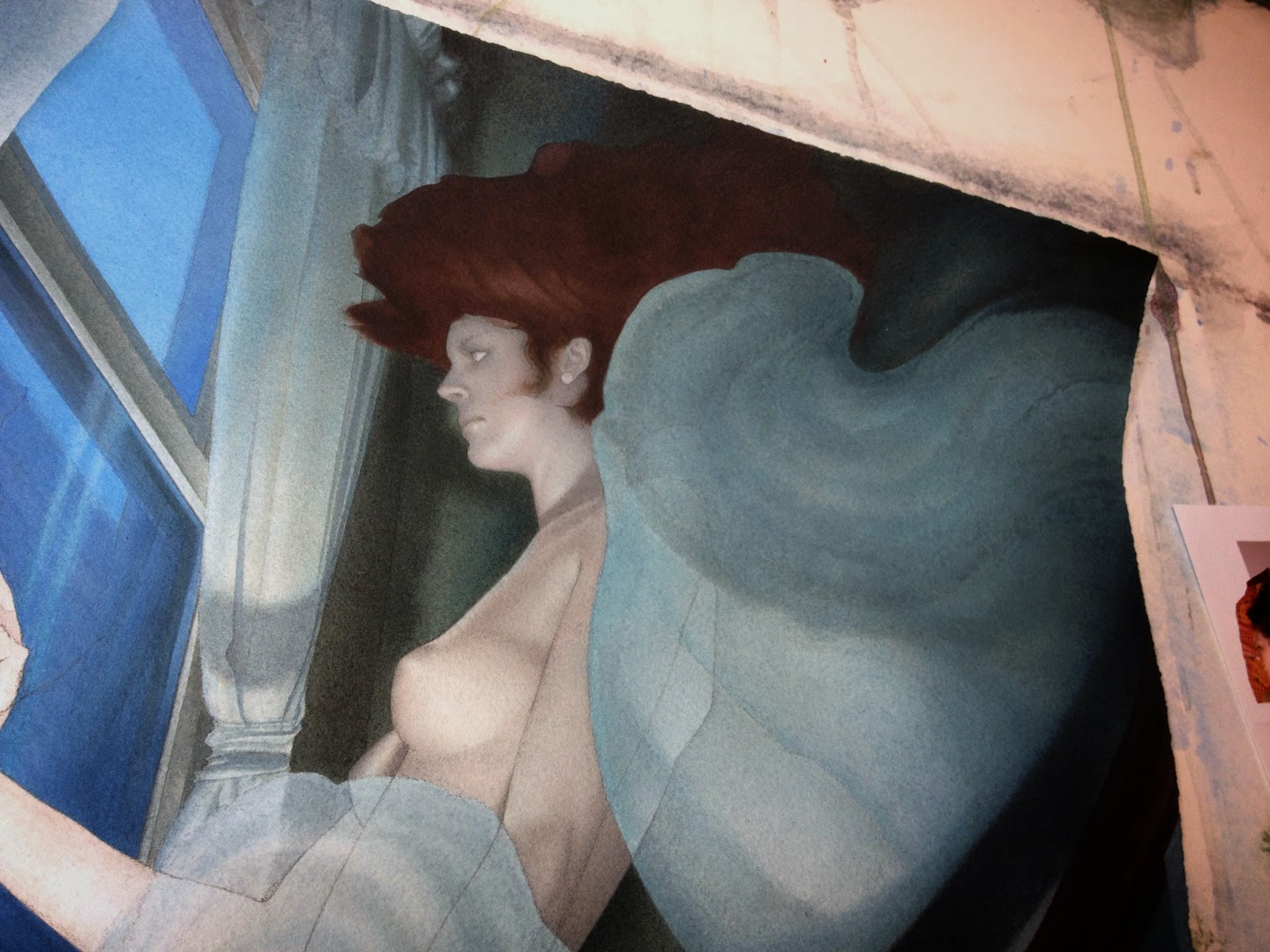
Currently staring at this and I'm now quite sure how I want to tackle this translucent drapery....
I think I'll paint some vases instead.
Currently staring at this and I'm now quite sure how I want to tackle this translucent drapery....
I think I'll paint some vases instead.
Tuesday, November 19, 2013
I Love This
Again, I'm reminded here of what it means to live a successful life and what we are often told by society equals a successful life. Check out the entire comic Here :)
Subscribe to:
Posts (Atom)