
Friday, June 15, 2012
Progress

Friday, June 8, 2012
Final Drawing

Something New

Below are some better images of my thumbnails I'm working from.


Saturday, June 2, 2012
How to Make a Free Website in Less Than 10 Minutes

This is an excellent post by Dan Dos Santos I thought worthy of sharing in case you missed it on MuddyColors. Check out the post here
Friday, May 25, 2012
Spectrum Live
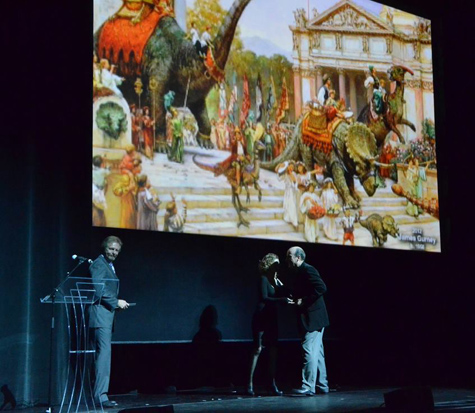
I finally got home from my road trip to the Spectrum Live Convention. A very inspiring weekend to say the least. For anyone interested in more of the goings on Irene Gallo did an excellent write up of the weekend here
another post on Muddy Colors by Donato here
and a listing of some photo galleries of the weekend here
Enjoy :)
Tuesday, May 15, 2012

Wednesday, April 18, 2012
Extrinsic Motivators and Creativity

I've been reading some interesting literature on the science of motivation in human behavior. The book is "Drive: The Surprising Truth About What Motivates Us" by Dan Pink. In the book Dan presents what four decades of scientific research tell us about what it is that motivates humans.
For a quick intro into extrinsic and intrinsic motivators and how they affect us here's one of my favorite RSA videos.
So how is this relevant for artists and other creatives? Below is an excerpt from the book "Drive".
"Something similar seems to occur for challenges that aren’t so much about cracking an existing problem but about iterating something new. Teresa Amabile, the Harvard
Business School professor and one of the world’s leading researchers on creativity, has frequently tested the effects of contingent rewards on the creative process. In one study, she and two colleagues recruited twenty-three professional artists from the United States who had produced both commissioned and noncommissioned artwork. They asked the artists to randomly select ten commissioned works and ten noncommissioned works. Then Amabile and her team gave the works to a panel of accomplished artists and curators, who knew nothing about the study, and asked the experts to rate the pieces on creativity and technical skill.
“Our results were quite startling,” the researchers wrote. “The commissioned works were rated as significantly less creative than the non-commissioned works, yet they were not rated as different in technical quality. Moreover, the artists reported feeling significantly more constrained when doing commissioned works than when doing non-commissioned works.” One artist whom they interviewed describes the Sawyer Effect in action:
Not always, but a lot of the time, when you are doing a piece for someone else it becomes more “work” than joy. When I work for myself there is the pure joy of creating and I can work through the night and not even know it. On a commissioned piece you have to check yourself—be careful to do what the client wants.
Another study of artists over a longer period shows that a concern for outside rewards might actually hinder eventual success. In the early 1960s, researchers surveyed sophomores and juniors at the School of the Art Institute of Chicago about their attitudes toward work and whether they were more intrinsically or extrinsically motivated. Using these data as a benchmark, another researcher followed up with these students in the early 1980s to see how their careers were progressing. Among the starkest findings, especially for men: “The less evidence of extrinsic motivation during art school, the more success in professional art both several years after graduation and nearly twenty years later.” Painters and sculptors who were intrinsically motivated, those for whom the joy of discovery and the challenge of creation were their own rewards, were able to weather the tough times—and the lack of remuneration and recognition—that inevitably accompany artistic careers. And that led to yet another paradox in the Alice in Wonderland world of the third drive. “Those artists who pursued their painting and sculpture more for the pleasure of the activity itself than for extrinsic rewards have produced art that has been socially recognized as superior,” the study said. “It is those who are least motivated to pursue extrinsic rewards who eventually receive them.”
This result is not true across all tasks, of course. Amabile and others have found that extrinsic rewards can be effective for algorithmic tasks—those that depend on following an existing formula to its logical conclusion. But for more right-brain undertakings— those that demand flexible problem-solving, inventiveness, or conceptual understanding—contingent rewards can be dangerous. Rewarded subjects often have a harder time seeing the periphery and crafting original solutions. This, too, is one of the sturdiest findings in social science—especially as Amabile and others have refined it over the years.10 For artists, scientists, inventors, schoolchildren, and the rest of us, intrinsic motivation—the drive do something because it is interesting, challenging, and absorbing—is essential for high levels of creativity. But the “if-then” motivators that are the staple of most businesses often stifle, rather than stir, creative thinking. As the economy moves toward more right-brain, conceptual work—as more of us deal with our own versions of the candle problem—this might be the most alarming gap between what science knows and what business does.”
I find this type of research fascinating. If you're low on time for reading but are looking for more insight on the topic here's a more in depth Google Talk where Dan states
"Being an artist is really, really hard ok? Doing anything well is really, really hard. It's takes a really long time. And you're less likely to stick with it if you don't really love it. And so, because they really loved it, it was "what I do", they got a lot better at it. "
If you do have time and are looking for more there's one other book on my reading list dealing with the affects of extrinsic motivators and incentives called "Punished by Rewards" by Alfie Kohn. For all the students out there grades are indeed a form of reward. So what does research say about the affect grades have on motivation? You might want to check out Alfie's book from your local library to understand more and maybe even share it with your teacher.
Subscribe to:
Posts (Atom)